| Welcome, Guest |
You have to register before you can post on our site.
|
| Online Users |
There are currently 2836 online users.
» 13 Member(s) | 2816 Guest(s)
Applebot, Baidu, Bing, Facebook, Google, Twitter, Yandex, davidjackson, JustAnotherTheory, Mauro, quimqu, RadioFM, Rafal, Ruby Novacna
|
|
|
| Authentic replication |
|
Posted by: R. Sale - 04-01-2018, 01:23 AM - Forum: Imagery
- No Replies
|
 |
The matter of authentic replication seems at first to be a purely visual situation. It is simply a determination that the item under consideration, the one that looks most like the original item, is the most authentic replication. And conversely it is often perceived that the lack of visual similarity carries with it a reduction, even the elimination of authenticity. This position can even become dogmatic.
This is where the creator of the VMs demonstrates a masterful talent with medieval information and the ability to improvise, to cant, and to compose. The composition is a puzzle. Improvisation occurs through visual trickery and optical illusion. Reality has been hidden behind a façade of fictitious existence. And in seeing only the façade, the reader is deceived and diverted from any investigation of how the VMs really does show connections to historical reality.
The talent of the VMs creator is not seen in the replication of visual similarity. That talent is shown in the ability to create an illustration in which a strong visual divergence can still exhibit a significant ideological similarity with the original, historical images. And the best example is the comparison of VMs You are not allowed to view links. Register or Login to view. with the Oresme cosmos (BNF fr 565). And that comparison suggests a series of propositions.
· The Oresme model of the cosmos is not common in medieval sources.
· The Oresme cosmic structure is relatively uncomplicated. It consists of three parts: an elemental (inverted) T-O representation of the earth, a starry field, and a cloud band.
· The VMs cosmos presents a similar, uncomplicated structure in that it is also constructed without the typical, planetary orbits.
· The parts represented in the VMs correspond to the parts used in Oresme in an interesting way. They are clearly different in their appearance, but there is reason to interpret that appearance in a very similar manner.
· Thus the comparison shows a clear structural analogy and a strong ideological similarity in the details of the corresponding parts – with the option of enhanced visual similarity through the combination with the Central Rosette cloud band.
· The combined use of visual discrepancy, often created though artistic ambiguity, and ideological similarity is the method by which the VMs creator has disguised the hidden historical content in this mysterious text. The use of this methodology is intentional. Deception is intentional.
· The general failure of modern investigation is the reliance on visual similarity, while at the same time recognition is blocked by the inability to recognize the necessary sources and their corresponding ideological details.
|

|
|
| [split] Humanist handwriting in the MS? |
|
Posted by: -JKP- - 29-12-2017, 10:50 AM - Forum: Codicology and Paleography
- Replies (24)
|
|
I have more than a thousand samples of handwriting that I specifically culled from many thousands of manuscripts due to their similarity to the column text, the main text, and the marginalia.
I also have enough background in this area to have some expertise at this.
I have hundreds more "reference" samples, some of which are hybrid or transitional between the 1) Italic and Humanist/Secretary hands and 2) the proto-Gothic and Gothic cursive hands, along with more pure examples of each and some of their related styles (e.g., Anglicana, which is a cousin to Gothic cursive).
My observations so far (I've been working on this for many years):
- I'm reasonably confident that the You are not allowed to view links. Register or Login to view. column text is Italic/Humanist/Secretary hand (the differences are small and I'll explain them in more detail later along with more correct terms). I have many samples to support this. I'm close to pinpointing a date and location (it took several hundred samples before even I began to consider dates and locations because I don't think it's good science to rush this and guess from a small set of samples).
- The marginalia is an early Gothic cursive blended with a small amount of Gothic book hand (this is not unusual since some people learned both hands). I have many hundreds of carefully selected samples, a half a dozen of which score in the 80s (out of 126) on a mathematical scale keyed to the reference marginalia. I also know which letter forms are specific to this hand (I can document this) so that the hand can be recognized.
- I'm reasonably confident that the main-text writers were familiar with Gothic cursive scribal conventions and abbreviations and I have some reference hands that are mixed Humanist/Gothic (that sounds like a contradiction but they do exist, they include both Gothic forms and Italic spacing conventions) that come somewhat close, and I have also identified which key shapes are unique to the main script, and which ones are common to many (I have done the same with the marginalia). It's very important to keep in mind that ciphers are often written with different spacing from a person's regular hand. There are many historical examples that show cipher shapes are often closer to a person's printing than to their handwriting. IF the VMS is ciphered text, the spacing will not necessary reflect the person's handwriting, but some of the letterforms may (e.g., a and o).
The reason I haven't written this up is because it takes time to do it right. With the zodiac symbols, for example, I didn't want to quote statistics or make generalizations until I had at least 500 complete cycles, and it took many years to find and key them. If you use a small sample, it's supposition and guesswork—a larger sample, and a little bit of actual math and scientific inquiry comes into play.
My feelings about the text are the same. I didn't want to make generalizations and write it up until I had culled at least 1,000 samples from extant manuscripts that were CLOSE to the hands in the VMS, with information about their dates, origins, etc.
I wanted to devote another year to studying this before making any of the above generalizations, but once topics are brought up on the forum, they tend to take on a life of their own, with everyone jumping in the pool, and often going over the same ground and collecting and posting the same items I already have in my files. Once the ball is rolling, I have no choice but to climb on the wagon and present what is incomplete (compared to what I had planned). If I don't, there's a huge replication of effort (plus I get accused of copying other people's work).
This is not a criticism, it's just the way it is when a community pools its resources relative to someone working independently. I had hoped to write this up as a paper—not because I had thoughts about getting it published, but because some topics are better treated this way. It's far too extensive to post as blogs (it would take 20 blogs just to lay a foundation for understanding it).
-----------------------
The column-text hands I posted You are not allowed to view links. Register or Login to view. (from You are not allowed to view links. Register or Login to view., later in You are not allowed to view links. Register or Login to view. and You are not allowed to view links. Register or Login to view.) are just the tip of the iceberg. Not only do I have much more in my files than I can fit on a blog-chart but I have found some important additional data since the last time I posted it.
I have also done an in-depth study of the foliation and quire hands and I have data that shows the foliation may not be John Dee's hand (it is very similar to Dee's hand but I have located a couple of other hands that might be considered more similar).
The research I've done on the marginalia far exceeds the work on the column text. Here is a quick grab (very quick) of some of the ca 1,000 hands I've collected (these are ONLY hands that bear a significant resemblance to the marginalia, I have many more hundreds that are reference hands or which match other parts of the text):
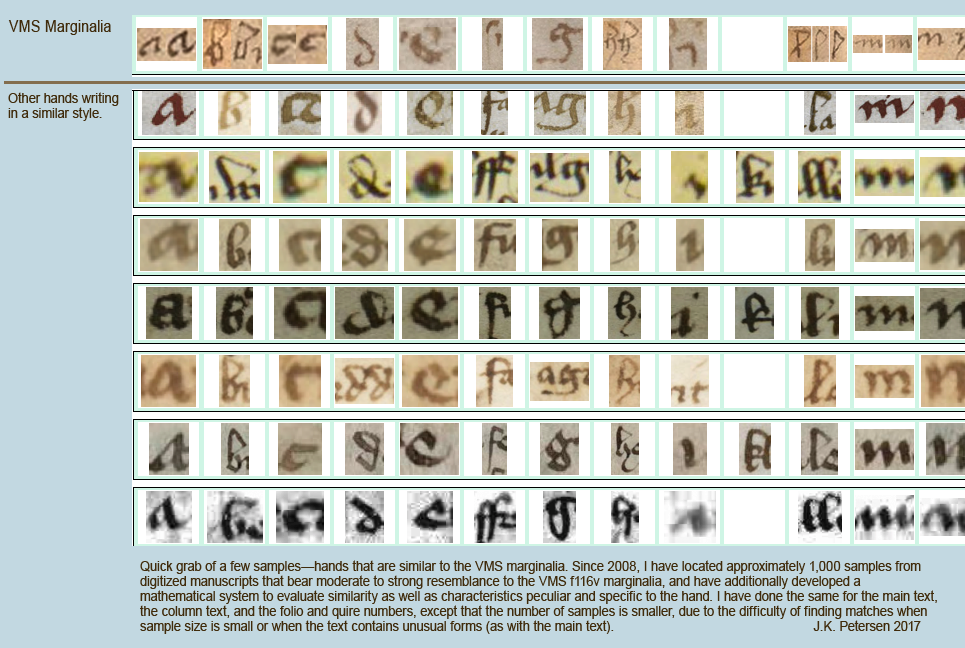
One of the things one notices when looking at the dates of the manuscripts represented by these hands is that they are within the same general ballpark as the radio-carbon dating for the VMS, which indicates that the last-page marginalia may be contemporary with the creation of the manuscript, or added within a few decades of its creation.
Note: I did not look for hands that were specific to the 15th century. I consistently searched hands from about 900 CE to about 1720 CE, but only those manuscripts (or marginal commentaries) that were written around the 15th century (give or take about 40 years) tend to exhibit this style.
|
|
|
|
| Humanist handwriting in the MS? |
|
Posted by: ReneZ - 29-12-2017, 09:10 AM - Forum: Codicology and Paleography
- Replies (49)
|
 |
Already in December 1995 Jim Reeds reported about a discussion that he and his wife had with the Italian herbalist Sergio Toresella, who had visited the Beinecke library where he had spent some time with the Voynich MS.
One of Toresella's observations, which was clearly supported by Jim, was that the handwriting in the MS was in an Italian humanist hand.
This observation was supported much later by a Spanish handwriting expert: Juan Jose Marcos, who further pointed out that this type of handwriting was used only by educated people.
It has always remained a bit of a question what to do with this information, and how the humanist strive for good form can be reconciled with the amateuristic and not all that elegant drawings in the MS.
Just a few weeks ago, I received a very interesting tip about this from Michelle Smith. I wanted to write about it earlier, but then other things happened.
One of the early Italian humanists was born as Zomino, but he changed his name to Sozomeno (1387 - 1458). He was born and died in Pistoia, and studied in Padova from 1407-1413. He entered the clergy already at an early age, and met other humanists in Florence (where he knew Poggio).
He did several of the 'usual' humanist things such as composing greek and latin grammars, and commenting on many classical authors. He built up his own library, which he donated to the city of Pistoia in 1423.
Here are some links (all in Italian):
You are not allowed to view links. Register or Login to view.
You are not allowed to view links. Register or Login to view.
What is unique about him is that his change from a standard gothic handwriting style to a humanist handwriting style is fully document and can be followed in his works. This is explained in detail You are not allowed to view links. Register or Login to view. .
What most attracted my attention was the picture that Michelle sent to me:

I have not been able to find this one back on the net, but there are a few others:

The marginal writing and drawings are confirmed to be in Sozomeno's hand.
I am not at all trying to argue here, that Sozomeno is suddenly a candidate for having written the Voynich MS.
However, the almost doodle-like marginal illustrations do have a very familiar ring to them.
|
|
|
|
| Voynich manuscript is decoded |
|
Posted by: Andy123 - 15-12-2017, 11:50 AM - Forum: News
- Replies (8)
|
|
Hello everyone!
I'm glad to tell, that this document was decoded. It took 16 years to do this hard work for one man.
He just wrote a book about this.
Book you can find here: You are not allowed to view links. Register or Login to view.
|
|
|
|
|