| Welcome, Guest |
You have to register before you can post on our site.
|
| Online Users |
There are currently 2789 online users.
» 10 Member(s) | 2772 Guest(s)
Applebot, Baidu, Bing, Facebook, Google, Twitter, Yandex, Jorge_Stolfi, Mauro, ololololo, pjburkshire, Radim Dobeš, Rafal, yinyang2024
|
| Latest Threads |
Old Czech (Bohemian) or M...
Forum: Theories & Solutions
Last Post: pjburkshire
Less than 1 minute ago
» Replies: 30
» Views: 1,897
|
[split] Does Voynichese e...
Forum: Analysis of the text
Last Post: nablator
54 minutes ago
» Replies: 45
» Views: 2,454
|
Zodiac Imagery: Manuscrip...
Forum: Imagery
Last Post: DG97EEB
1 hour ago
» Replies: 50
» Views: 8,903
|
Francesco di Giorgio Mart...
Forum: Imagery
Last Post: JustAnotherTheory
2 hours ago
» Replies: 40
» Views: 4,920
|
Voynichese is a numeric c...
Forum: Theories & Solutions
Last Post: Mauro
10 hours ago
» Replies: 252
» Views: 48,287
|
No text, but a visual cod...
Forum: Theories & Solutions
Last Post: bi3mw
Yesterday, 09:53 PM
» Replies: 1,950
» Views: 1,500,423
|
New missing piece: Córdob...
Forum: Provenance & history
Last Post: Mauro
Yesterday, 08:48 PM
» Replies: 1
» Views: 148
|
Not Deciphering The Voyni...
Forum: News
Last Post: Mauro
Yesterday, 08:42 PM
» Replies: 2
» Views: 226
|
Proposed Manuscript Chron...
Forum: Theories & Solutions
Last Post: RadioFM
Yesterday, 07:26 PM
» Replies: 66
» Views: 13,658
|
The evolution of P/F vs T...
Forum: Analysis of the text
Last Post: Mauro
Yesterday, 07:16 PM
» Replies: 15
» Views: 618
|
|
|
| List of line-initial words that only appear line-initially? |
|
Posted by: nickpelling - 22-02-2017, 09:48 AM - Forum: Analysis of the text
- Replies (8)
|
 |
Has anyone compiled a list of line-initial words that only appear line-initially?
I was reminded of this by a 2008 Cipher Mysteries post (which I had inevitably forgotten about until stumbling over it yesterday) where I mentioned that Marke Fincher had pointed out to me that ycheo[-] and ysheo[-] only ever appear line-initially, along with something similar with dche[-].
You are not allowed to view links. Register or Login to view.
|

|
|
| Scribal hands and Currier languages |
|
Posted by: Koen G - 14-02-2017, 08:20 PM - Forum: Analysis of the text
- Replies (15)
|
 |
While writing my latest blog post, I read on Rene's site You are not allowed to view links. Register or Login to view. that Currier concluded that six to eight scribes wrote in the manuscript. That's main text, ignoring marginalia. I have no experience with telling apart different handwritings, so I thought I'd ask here.
Has this been confirmed? Has anyone else studied this in detail?
Of how many hands can we be certain? Again, only considering core text, not marginalia or quire numbers.
And how do the different hands correspond to Currier A and B?
And are we even certain about the clean distinction between these "languages" to begin with?
|
|
|
|
| foldouts line transcriptions |
|
Posted by: Davidsch - 08-02-2017, 07:39 PM - Forum: Physical material
- Replies (4)
|
 |
During analysis of the text I've located an anomaly
Often this an indication there is something wrong.
It surprised me that after all this time I did not notice it before,
and rather inconvenient, because now I realize many (of my old) statistics are actually false.
The foldouts, have a transcription which is spread along the width of the foldouts !!
f101r1 => the transcript is actually of page f100v + r1 + r2.
By inspection it sounds logical. But it is rather special, having such long lines of text !!
f101v2 => i did not know this is a foldout !! Now You are not allowed to view links. Register or Login to view.
tells that f101v2 actually holds the transcript for 101v2 + v1 !!
Since there is no picture of the foldout, I do not know if the text really is 1 long line,
or that actually the text has to be cut up into 2 pages.
Zandbergen writes: "There are 10 lines of text in three paragraphs, all at the bottom of the page. The text crosses the vertical fold between f101v2 and f101v1 and spans the total width of the foldout folio. The last line has been centred, also in the middle of the pair of pages. The fold, which is rather damaged, makes reading of part of the text very difficult."
But, You are not allowed to view links. Register or Login to view., tells that
# This page spans two normal-size panels (f101v2 + f101v1) in a
# four-panel fold-out folio. They were originally entered as two
# separate pages (f101v2 and f101v1). However the text and plants
# clearly connect across the joining fold. [Stolfi]
I would like the possible to decide for myself if it is or is not a long line of text.
Unfortunately, I did not find such a picture of the entire stretched foldout.
f89r2
You are not allowed to view links. Register or Login to view.
It is not difficult to see that indeed the text is written as one long line along 89r2 + r3
f89v2
It is not difficult to see that indeed the text is written as one long line along 89v3 + v2
---
Question to René "so called" Z.: are there more texts which are really long foldout texts?
|
|
|
|
| What is the VMS text? |
|
Posted by: stellar - 07-02-2017, 11:29 PM - Forum: Analysis of the text
- No Replies
|
 |
I believe a poll here is needed for sort of a guide that everyone can see and maybe agree upon. There are many perspectives and theories of just what the text is. Maybe a consensus can be reached regarding the VMS text by people who have been working in Voynich studies for years. I will leave this as an ongoing poll and open so that we can acquire the most data on the texts meaning relating to what it could be.
Please part take in this experiment as it will be beneficial to all. Your input is valuable regardless of how long you have held your ideas about this subject. Also as time goes by and if your ideas change just state that here in a post. We have to share more on this topic as if we have enough input maybe we could target the text in a more coherent manner. I find that the most interested minds with a great deal of time invested in this subject may point us in the right direction; as to move most of us in a similar direction in targeting the Voynich Manuscript methodology for a possible reading or not.
|
|
|
|
| The pragmatic nature of the script |
|
Posted by: davidjackson - 07-02-2017, 08:36 PM - Forum: Analysis of the text
- Replies (24)
|
 |
I am always amazed by the pragmatism shown in the creation of the glyphs used in the VMS.
Medieval code glyphs tended to be elaborate. It was almost as if, when deciding to sit down and create a cipher glyph, the average cryptologist would say "the more elaborate, the more over the top and impressive, the more secret it will be".
OK, not always. But you can divide them into two types - the functional and the ornate. The first were designed to be used, the second designed to be shown.
Ornate ones are the impractical ones devised to impress. Look at the Arabian secret writing tradition; or the John Dee's Enochian.

Another is the Alphabetum Kaldeorum, which was a simple 14th century cipher alphabet invented by Austrian king Rudolf IV:

Rudolf is reputed to have claimed that the alphabet was from India, but this appears to have been a misdirection. It's generally assumed that Rudolf invented it (or had someone invent it for him), as he was proud enough of the system to have it engraved on his epitaph. Some have argued that the letter shapes bear a resemblance to the theoretical cipher alphabet of Aethicus Ister, a work which we know about only at third or fourth hand, but which argued for the substitution of letters in order to secure the reading of the text. It's been suggested that the work was written by the 8th century Bishop of Salzburg, St. Virgil the geometer. St. Virgil was actually an Irish missionary who travelled the continent, and who had a major falling out with St. Boniface, who twice denounced him to the Pope for heresy. Other researchers have linked Aethicus Ister to other intellectuals of the period across the whole of Eastern Europe. If so, it's perfectly possible that a copy of his work was studied by someone in Rudolf's court who appropriated his ideas for his masters new code idea.
Although we appear to have no actual diplomatic correspondence written in this cipher, we do have a manuscript from 1428 which, along with some other non-European alphabets, describes the Alphabetum, (it resides at the University of Munich with the not very exciting shelf name of UB München 4° Cod. ms. 810).
These codes weren't designed to blend in, or to be easy to write. They were designed with the idea of secrecy in mind, but with no attempt at ease of use. Note the AK wouldn't be easy to write - we don't have any examples of it in use, but each letter would have to be individually written carefully to avoid confusion. M and Z would be very easy to confuse, as would I and K, etc.
Here's a medieval code from a You are not allowed to view links. Register or Login to view. (you can easily see the difference between the enciphered portion and the plain text)

They are like this because they weren't designed to encode an entire book, only phrases or even words. The idea of encoding a whole book didn't appear until literacy was high enough to warrant this; indeed, in the middle ages the word "cipher" didn't even exist. The idea was always to hide the most important, key point. In all the medieval cipher manuscripts I know of, only key words or phrases are encoded.
For more pragmatic and smoother approaches, we have to wait for the Renaissance. Such as the Spanish diplomatic codes from the 16th century, which substituted abbreviations for phrases in a code book:
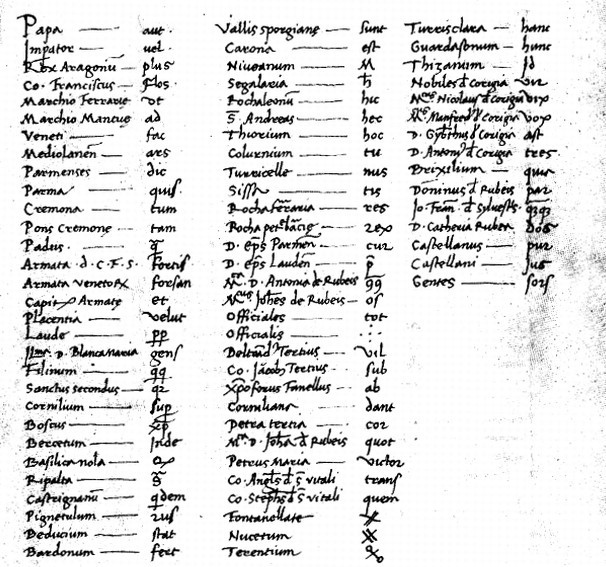
That's when codes actually start becoming useful, and people realise that it's a good idea to a) be easy to write and read and b) not stand out too much.
But the Voynich glyphs are different. Obviously they stand out, but they were designed from the very beginning to be easy to write and read.
There is another medieval code which comes to mind, namely the number ciphers used by monks across northern France and You are not allowed to view links. Register or Login to view.:

But the notae elegantissimae described above evolved through trial and error. They weren't trying to encode the numerical details (the code was used for counting, such as items in warehouses) but trying to substitute the clumsy Roman notation in use at the time. The code vanished as soon as Arabic numerals came along.
So - why did the Voynich scribe decide upon a fluid script for his book? It seems a nonsensical question to us today, but it's a completely revolutionary idea for the late middle ages. Did the script evolve? (shout out to Koen!) Or was it designed from the ground up?
I suppose we'll never know, but it's fun to speculate....
|
|
|
|
|



