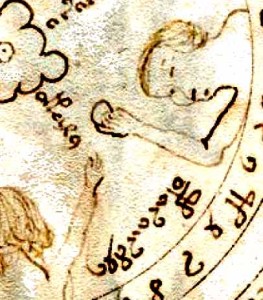
I'm working on a short blog post about nymph attributes, and I realized I had never looked properly at these guys before. Image contrast etc. has been altered:
Now there are some weird things about them. For starters, I think the faces are drawn in a different style than those in the other nymphy sections. They are all clothed. They all have two items, which is highly exceptional. How I interpret the items, very tentatively:
Top left (my image): container, product (bread? vegetable?) or gold?
Top right: container, cereal crop
Bottom left: holding yellow globe in one hand, pointing to an object with writing (??) with the other.
Bottom right: yellow thing in one hand, not sure whether the top part belongs with it, in that case it looks like a vegetable. White globe in the other. One can argue that the white globe is part of the background, but the way the hand is held suggests to me that it is an item.
Interestingly, a white globe is also held by this figure mentioned recently by Davidsch:
In both cases, the globe is held up in the figure's right hand (proper).
So what are your thoughts about these nymphs? Has the "writing" been studied before? It almost looks like som kind of tablet...
Some details on the Rosette page could make the difference. Currently i want to draw attention to You are not allowed to view links. Register or Login to view.
[attachment=774]
It is the left “road” on the page and the letter composition, and it has a very special name:
ddssShx
ddssShx
What we see here is a literal road, a path, a vein, a stump, or has it a symbolic meaning?
It is clear that it shows a connection between 2 parts of the page.
If we know, or can guess those parts, can we tell what this path is?
There are 3 labels on that “path”.
One on top, this one in the middle, and on the bottom.
ytedar
ddssShx
daldas
The position and the distance of the 3 words, shows us that the words do not belong to each other and do not form one sentence,
but must be used on itself, as labels.
Some ideas: corridor north, corridor south. Or names, China, Pakistan. Or purification of the mind, purification of the body.
Is it a path over water, or the path to heaven or hell ?
Then on the left and right of the path there are also two more labels:
soiindy
ofardy
In total we now have:
ytedar soiindy ddssShx ofardy daldas
Searching for matching occurrences gives:
ytedar: 3 matches, in f73v, f85r2 and f104v.
soiindy: none
ddssShx: none (dd occurs 25 times, ss occurs 33 times, x 44 times)
ofardy: none (fard: none, far: 3 matches, in f1r, You are not allowed to view links. Register or Login to view. textpage and You are not allowed to view links. Register or Login to view. herbal)
daldas: none (dalda: none, alda: none, daldar: none, aldar: 3 matches, in You are not allowed to view links. Register or Login to view. textpage, You are not allowed to view links. Register or Login to view. star textpage and You are not allowed to view links. Register or Login to view. herbal)
Further more, the letter x occurs 44 times in total, and in 7 words in the Rosette !
xar
xasashe
xoltedy
xdar
soshxor
dxar
There are three options for dd ss sh x, it is a label or it is a number, or is it both.
If dd ss Sh x would stand for a name, then dd ss must have a vowel in d or s at least.
Then it could stand for a word with this pattern (v=vowel, c=consonant)
d-d- ss
cvcv cc
or
-d-d ss
vcvc cc
... or all the combination where -d or d- of -s or s- represent vc or cv.
Are there such words, where the last letter of the word is a low frequent letter (such as x, y, z) ?
Sorry for the inconvenience
[url=https://www.facebook.com/787737484701521/photos/a.787769764698293.1073741828.787737484701521/793266497481953/?type=3&theater][/url]
Looking closely at f86r, the so-called "Covered Pool" illustration, I just noticed a feature I hadn't seen before, and I want to bring it up here for discussion.
You are not allowed to view links. Register or Login to view.
Up until recently I had assumed that the vertical squiggly lines which extend into the pool from the "ceiling" were either steam rising or water pouring down, or maybe even some sort of supporting element like pillars or stems holding up the upper part.
But upon closer examination, I realized there was a problem with all of these interpretations. Look at this zoomed image:
The squiggles don't just hang down. Two of them actually connect together forming a U, like some sort of bunting/garland.
This feature seems to only occur on the far right of the image.
In factif we look at the whole pool, going from left to right:
the first three sets of vertical squiggles stop in midair, the fourth and fifth touch/dip into the pool water (unclear which because of green paint), and the last two form a U-shaped "bunting"-like shape: they are connected, either underwater or floating on the surface.
I'm really not sure how this can be explained or what it's meant to illustrate, but as far as I know, fluids don't behave this way.
While I was googling stuff for a reply to another post, I came across a Wikipedia entry for some Voynich-inspired music:
"Graft is an album by the Japanese noise musician Merzbow. The recording was inspired by the plant illustrations in the Voynich Manuscript."
Here's a YT link for the first track on the album, Graft #1:
You are not allowed to view links. Register or Login to view.
[url=https://youtu.be/p2FI-ntpxaE][/url]
It sounds like a pretty accurate rendering of what happens inside my brain when I spend too long looking at the Voynich plants.
I've been down a bit of rabbit hole over the last couple of days which others may have already been down. In particular I think Marco posted about Alfonso X's Lapidario before, but from that thread I'm not sure how deeply he investigated, as the thread petered out.
I was looking once more at the Zodiac folios, in particular Taurus. The Taurus Light and Dark folios are both marked "may" in, as often remarked, a later hand. There are 15 figures in each Taurus folio, for a total of 30. However, as we well know, May has 31 days, so the figures probably don't represent days. I thus went in search of 30-way splits of Zodiac signs ....
Looking at the old Spanish illustrated manuscript:
You are not allowed to view links. Register or Login to view.
which is a treatise on astrology and the importance of stones/gems etc., we can see a circular Taurus diagram with 30 divisions. Each of these divisions is associated with a stone, of a noted colour, and one or a few stars in a constellation. There is a lengthy description of each division, it's stone, its stars, the various ailments the stone cures, when the stone should be used et cetera. There is a Spanish transcription of the text here, which I found very useful (combined with Google Translate):
You are not allowed to view links. Register or Login to view.
Since a plausible language match to the month spellings as written in the Zodiac folios is Occitan, a region of Spain., there seems to be a compelling regional match here, but I can't quite figure it out. From what I read, Alfonso X assembled a team of scholars from all world regions, who worked on documents on a variety of topics. You are not allowed to view links. Register or Login to view. says of the Lapidario: "The Lapidario is a thirteenth century Castilian translation sponsored by King Alfonso X el Sabio, the Learned. The translation was done from an Arabic text which in turn is said to have been translated by the mysterious Abolays from an ancient text in the "Chaldean language""
Anyway, my first approach was to try to match the colours of the headgear or tunics of the clothed figures in the Taurus Light folio to the colours of the first and second fifteen stones mentioned in the Lapidario. It's a little tricky, because although the stones are numbered, we don't know which is figure 1 in the Taurus Light folio, and whether the inner ring precedes the outer. Even so, the patterns of colours in the stones sequence might reveal a match. I drew a blank.
My second approach was to try to match the names of the stones with the labels on the figures, to see if there was some correlation between the label length, or its initial glyph, with the stones' names. Very tricky.
Some of the stones that appear in the Taurus set of 30 also appear in other Zodiac signs in the Lapidario. For example, the ninth stone in Taurus is "esmeri(l)", and esmeril is also the third stone of Libra, and the second stone of Aquarius.
This leads to the obvious question: is there a Figure in the both the Voynich Taurus and Libra roundels (Aquarius is missing) that shares the same label? If so, might that label be "esmeril"? And, are there other stones that appear in more than one sign which might be matched to duplicate stones in the Lapidario?
As an aside, regarding the stones and colours, I was struck by the third stone of Taurus, called "camorica", which is scarlet in colour and associated with the Pleiades.
Has anyone else looked at all this before and found anything more concrete?!
There has been so much interest shown in my so-called "Libri theory" that I thought I might add a thread here.
If you want to skip the introduction and go straight to the details, see the list of posts below.
For those who prefer a summary:
As far as I was able to discover* nobody in Voynich studies had ever heard of Guglielmo until I began writing up a few posts in 2015, not only because he was in the right place at the right time to give or to return books to the Jesuits, via Fr.Beckx, but because if Beckx had gained the manuscript from Libri, then all bets are off about where it had been kept between the last quarter of the seventeenth century and 1910-12.
_* some people don't think it necessary to acknowledge precedents, and don't like to pass on such information.
Libri was a member of the minor nobility in Italy, apparently a bit of a social climber, and his great friend was a certain nobleman named Manzoni, whose own library at his death was counted as 300, 000 volumes (yes, hree hundred thousand).
Both men lived in Florence and both - I think - had smaller villas in Fiesole.
Guglielmo Libri developed a habit of helping himself to other libraries, perhaps as a way to increase his own social standing, and have something to talk about to the man he so admired, Count Manzoni.
When the Napoleonic wars resulted in the contents of many libraries in Italy being stolen or confiscated, or simply claimed as French in areas taken by Napoleon, our dear Guglielmo wangled his own appointment as "overseer of French libraries". including also an office as Administrator of the “ecclesiastical patrimony of Prato” [ref: Maria Fubini Leuzzi, ‘Guglielmo Libri amministratore …];
Prato links to a certain Datini - but don't you dare! I'm still working on that topic and already published a "Statement of Intention'.
Once he had obtained that official position, Libri's thefts became more numerous and finally more obvious - ito the point where he had to leave France. He aarrived in England with trunks and trunks of rare medieval monastic and secular manuscripts, some certainly as old as the seventh and eighth centuries (i.e. before Charlemagne)
So that is could be why, when Wilfrid arrived in England a couple of decades later - another continental aristocrat with trunks and trunks of medieval manuscripts, one expects that the English might feel a little wary of any very unusual elements in his collection.
By 1868 Libri sensed his death imminent and returned to Florence with what books he'd not sold in England, soon moving up to the small hilltop village and nobles' place of retreat 10 kilometers away, in Fiesole.
According to the Jesuits' offiical history, Fr. Beckx had gone direct from Rome to Fiesole in the 1860s, as Jesuits were being expelled from Rome. He apparently remained there in a former 'Hieronymite' house that had been built by Cosimo de medici on the hill behind the Medici villa.
This old hermitic centre the Jesuits bought. So they inherited anything in it, too. (Interesting..)
Guglielmo passed on most of his remaining collection (not all stolen) to his friend, Count Manzoni, who also had a house in Fiesole. So we can suppose Fiesole held about 350,000 collectable MSS by now.
Guglielmo then died, around the middle of 1869.
Fr. Beckx didn't return to Rome until 1873.
In the meantime, the late Guglielmo's manuscript collection seems to have shrunk, or vanished from the house of Manzoni.
I suppose it's possible that Manzoni took some, but the historical record doesn't suggest he did that.
So Perhaps on his deathbed, Guglielmo had wished to see the most important Jesuit in Italy, who was just up the road, and ask him to organise the return of any illegally-acquired books he still had, to leave this life with a clear conscience. Who knows?
And then finaly... as postscript, a thread recently published here led Rene and Ellie V to mention that Fr. Strickland - who served as middleman between the Jesuits in Rome, and Wilfrid Voynich - once wrote to Wilfrid telling him that for the convenience of the current Provincial, Wilfrid should send the "1,000 books" that Wilfrid had selected to the Jesuit house in florence, where the current Provincial would be able to check them over before they were sent on to Rome.
So what do you think? "The castle" an Italian "palazzo"? The Jesuit Villa, or Count Manzoni's house in Fiesole? The Medici villa?
So the story so far is that we have Fr. Strickland and "1,000 volumes" and Wilfrid Voynich all in the vicinity of Florence - and perhaps ten kilometers from Fiesole, or in Fiesole and ten kilometers from Florence.
(On Wilfrid's own warehouse in Italy - see the original research by Rich Santacoloma, published on his blog. You don't have to accept his theory of a conspiracy).
But wait! There's more.
When Kraus donated the Voynich MS to Yale, he donated *at the same time* works certainly ones earlier "acquired" by Guglielmo Libri.
English collections also contain works that were acquired from a notable English bibliophile, and who in turn had purchased both from Libri and from Wilfrid.
So.. that's the introduction.
----
More details in the posts I put out while researching this previously untouched topic. (I expect that the usual suspects have filched the basic material and neglected to mention whose research they were helping themselves to... lots of Guglielmos around. Not so many Manzonis.
'You are not allowed to view links. Register or Login to view.You are not allowed to view links. Register or Login to view. (March 19th., 2015)
You are not allowed to view links. Register or Login to view. (March 20th., 2015).
'You are not allowed to view links. Register or Login to view.', (March 23rd., 2015)
'You are not allowed to view links. Register or Login to view.' (April 4th., 2015);
You are not allowed to view links. Register or Login to view.'. (April 23, 2015);
You are not allowed to view links. Register or Login to view. (30th., April 2015)
'... You are not allowed to view links. Register or Login to view.' (April 30th., 2015);
You are not allowed to view links. Register or Login to view. (October 6th., 2015)
'You are not allowed to view links. Register or Login to view.' (March 5th., 2016)